
Blog
Why Global HR Certifications Are Quietly Becoming a Hiring Filter in Bangladesh in 2026

A pattern has been forming in Bangladesh HR over the past few years that more professionals are starting to notice. It is not a sudden shift. It is not a crisis. It is a steady recalibration of what hiring teams at multinational employers, regional GCC recruiters, and increasingly large local conglomerates look for when they evaluate HR talent.
Internationally recognized HR credentials are becoming a more visible part of the HR career conversation here.
This is not the same as saying “you need a credential to get hired.” That is overstated. Many capable, experienced HR professionals in Bangladesh thrive without one. What is changing is that, in a more competitive HR job market, a credential signals something specific that is harder to demonstrate any other way: that you have studied and passed a globally standardized assessment of HR knowledge and judgment.
This article walks through what the data actually shows, what the credentials are, and what the realistic case for and against pursuing one looks like for an HR professional based in Bangladesh in 2026.
What the global data shows about HR certifications
Several published data points anchor this conversation. They are worth knowing because they cut through the marketing language that often surrounds certification programs.
PayScale conducted research on the impact of HR certification on career outcomes, the results of which are referenced by HRCI and other industry sources. Among the findings: HR-certified professionals report earning, on average, $10,000 or more per year than uncertified peers, and they report being promoted approximately 14 percent faster.
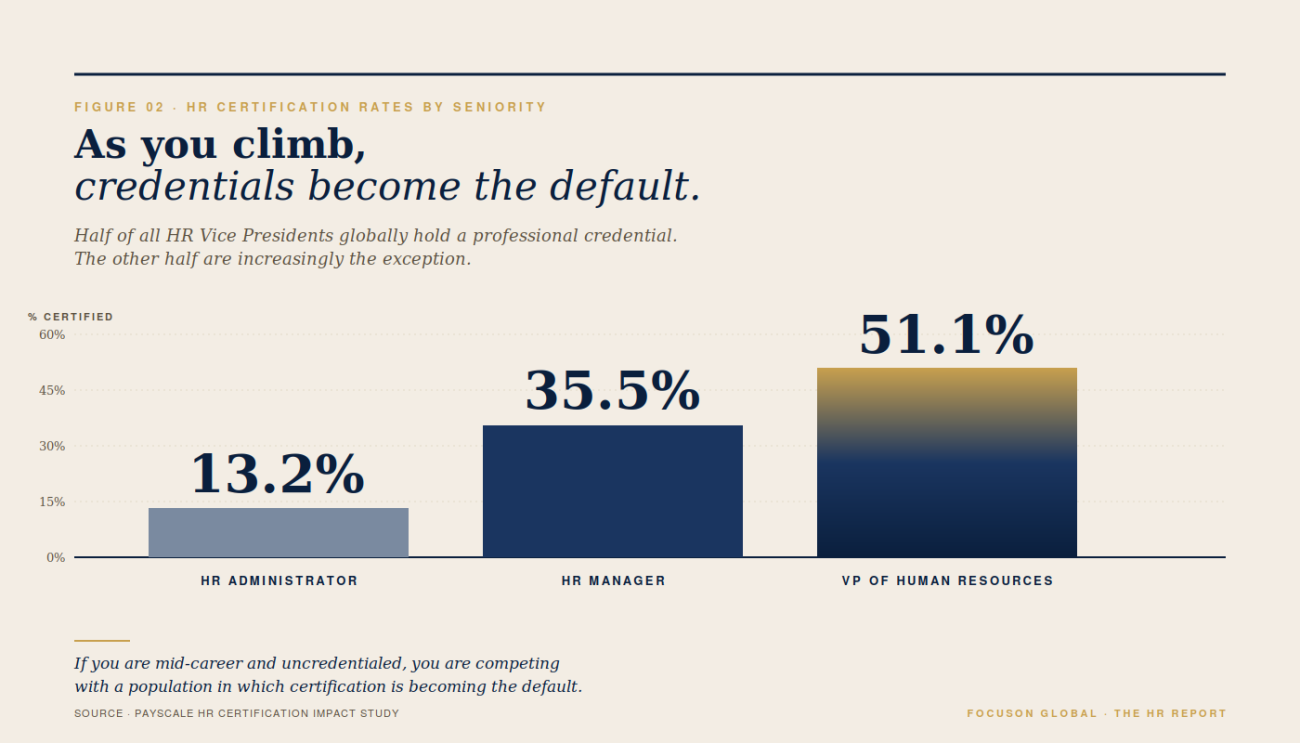
Certification holding rates also climb with seniority. Across PayScale’s data, roughly 13 percent of HR administrators hold at least one credential. The figure rises to about 35 percent among HR managers, and to roughly 51 percent among Vice Presidents of HR. The trend is observable in industry analysis broadly: as HR professionals advance, credentialing becomes more common.
These numbers describe a global pattern. They do not predict an individual’s outcome. But they tell us something useful: at the senior end of HR careers worldwide, a credential is now closer to a baseline expectation than to a differentiator.
The HRCI 2025 pass rates, in their own context
HRCI publishes its certification pass rates annually, in compliance with NCCA accreditation standards. As of December 31, 2025, the figures are:
- SPHRi: 76 percent
- aPHR: 71 percent
- PHR: 72 percent
- PHRi: 84 percent
- SPHR: 76 percent
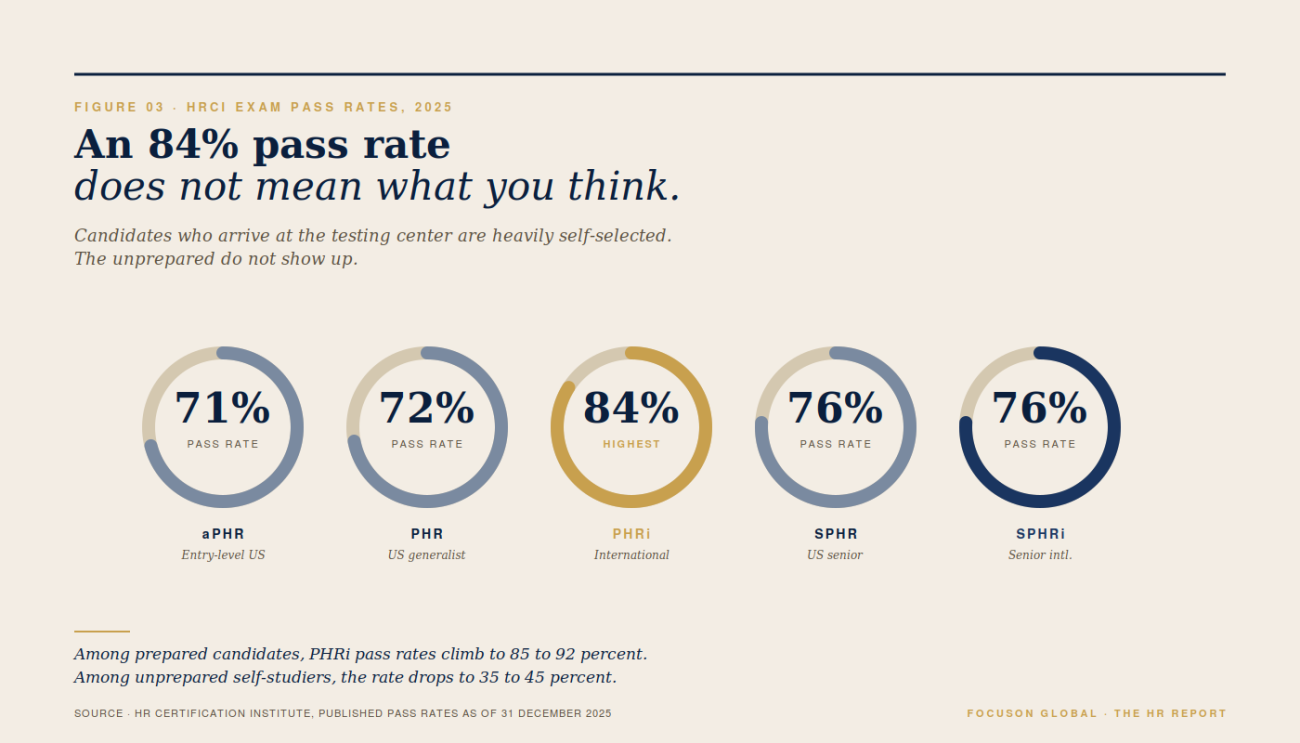
The PHRi rate of 84 percent often catches people’s attention. It looks favorable compared to the other figures and might suggest the international exam is easier. The honest interpretation requires a few caveats.
Pass rates reflect the population of candidates who actually sit for the exam, not the population who consider it. Because the exam fees are substantial (HRCI publishes the PHRi exam fee at $395 plus a $100 application fee, totaling $495), candidates tend to prepare seriously before testing. The unprepared often delay or do not test at all. That self-selection inflates pass rates relative to what a random candidate might achieve.
The exam itself uses a method called weighted scoring through the statistical Angoff approach. The passing scaled score is 500 on a scale of 100 to 700. Different questions carry different point values, which the candidate cannot see during the exam. This is similar to how the SAT and other standardized tests are scored. It means that “passing” is not as simple as getting a fixed percentage of questions correct.
The HRCI credentials that are most relevant to Bangladesh HR professionals
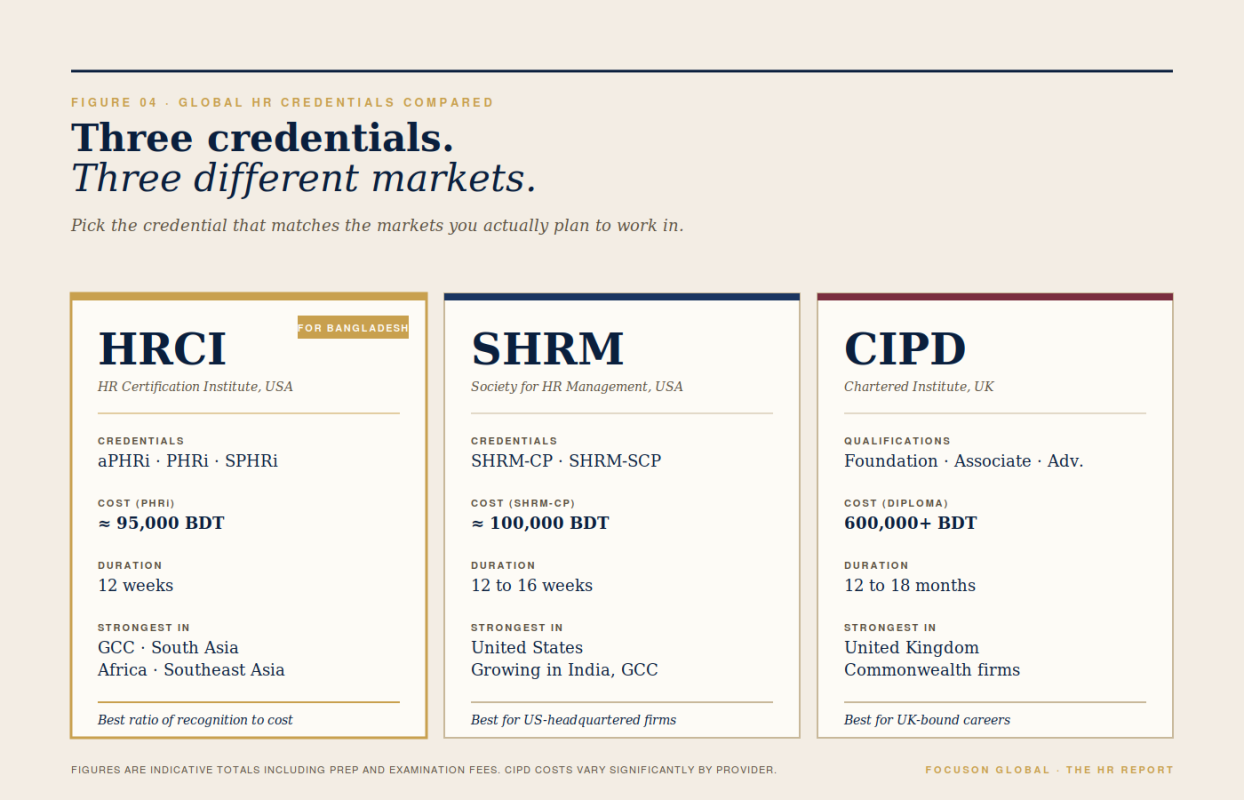
HRCI offers three internationally focused credentials. Each maps to a different career stage:
aPHRi™ (Associate Professional in Human Resources, International). The entry-level credential. Eligibility requires no prior HR experience, only a high school diploma or global equivalent. Suitable for those new to HR or pivoting into HR from another field.
PHRi™ (Professional in Human Resources, International). The mid-career credential for HR professionals doing operational and tactical work. Eligibility requires either a Master’s degree plus 1 year of professional-level HR experience, a Bachelor’s degree plus 2 years, or 4 years of professional-level HR experience without a Bachelor’s degree.
SPHRi™ (Senior Professional in Human Resources, International). The senior strategic credential. Eligibility requires either a Master’s degree plus 4 years of professional-level HR experience, a Bachelor’s degree plus 5 years, or 7 years without a Bachelor’s degree. SPHRi additionally requires submission of an Employment Law document during application.
All three credentials are valid for three years after testing. To maintain certification, holders must earn 60 recertification credits over each three-year cycle, or retake the exam.
For the SPHR and SPHRi specifically, HRCI requires that 15 of the 60 credits come from Business credit categories. For the GPHR, 15 credits must be in Global credit categories. For PHR and PHRi, all 60 credits can be HR (General) credits.
What the salary picture looks like for HR professionals in Bangladesh
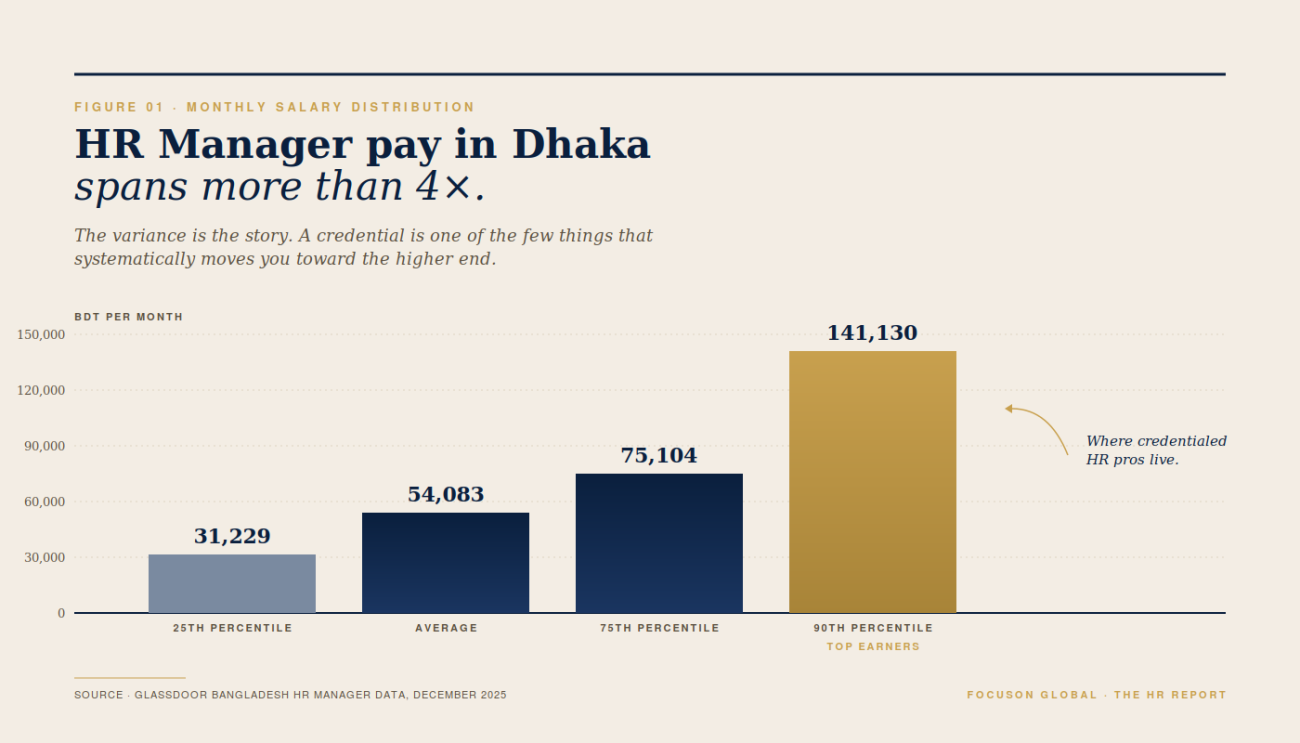
To make any sensible assessment of certification ROI, the salary baseline matters. Glassdoor data as of December 2025 shows the following for HR Manager roles in Dhaka and across Bangladesh:
- Average annual salary in Dhaka: approximately BDT 54,083 (Glassdoor reports this as monthly equivalent of roughly BDT 4,500, calibrated against 42 reporting employees)
- 25th percentile: approximately BDT 31,229
- 75th percentile: approximately BDT 75,104 to 80,104 (range varies slightly by data cut)
- 90th percentile: approximately BDT 141,130
PayScale’s Bangladesh data complements this. PayScale reports the average annual total compensation for an HR Manager in Bangladesh at approximately BDT 494,790 in 2025. Early-career HR Managers (1 to 4 years of experience) report annual total compensation around BDT 479,323. Mid-career HR Managers (5 to 9 years) report approximately BDT 911,842, based on PayScale’s reporting sample.
For comparison, Glassdoor reports that HR Director roles in Dhaka have a much narrower data set (a single confirmed reporting source as of November 2025), with reported compensation in the range of BDT 1,099,298 to BDT 1,193,412 annually.
A few honest observations about these numbers:
The variance in reported HR Manager pay in Bangladesh is wide. The 90th percentile is roughly 4.5 times the 25th percentile. That variance reflects real differences in industry, company size, multinational versus local ownership, and individual capability. Two HR Managers with similar years of experience can earn substantially different amounts.
The data sets are limited in volume. Glassdoor’s 42 HR Manager submissions and PayScale’s similar sample sizes mean the figures are directional rather than authoritative. Larger employer-internal salary surveys would offer more precision but are rarely public.
A credential is one of several factors that can move someone toward the higher percentiles. It is not the only one. Industry choice, language proficiency, employer prestige, and experience depth all matter. The credential is best understood as a contributor to upward mobility, not a guarantee of it.
Why this matters more in 2026 than it did five years ago
Several broader trends make this conversation more relevant now than it was in 2020 or 2021. Each is observable in the Bangladesh market and in the literature on international HR hiring.
Multinational HR hiring in Bangladesh has expanded. Several large multinational employers including buyer organizations in apparel, technology, FMCG, and retail have grown their in-country HR teams over recent years. Multinational employers tend to apply hiring practices consistent with their global organizations, which often include credential-based screening for HR roles.
Remote and outsourced HR roles for international employers have grown. GCC employers, US firms, and UK firms increasingly hire remote HR business partners and analysts in Bangladesh. In remote international hiring, candidates compete against peers from other emerging markets where credentialing rates are higher. A globally recognized credential helps Bangladesh candidates appear comparable on standardized criteria.
The HR talent pool in Bangladesh is becoming more credentialed. While exact numbers are not publicly tracked for Bangladesh specifically, conversations with HR leaders and conference attendance patterns suggest that credentialed HR professionals are a growing minority within the local community. The exact rates here are not measured in published data, but the trend toward more credentialing is consistent with global patterns.
These shifts do not mean uncredentialed HR professionals will be excluded from the market. They do mean that the absence of a credential is more noticeable than it once was, particularly when applying for roles at multinational, multinational-influenced, or international remote employers.
The realistic case for and against pursuing certification
The honest analysis has two sides. Both deserve consideration.
The case for pursuing HRCI certification:
The credential demonstrates a defined and globally consistent body of HR knowledge. Hiring teams who recognize HRCI know what passing the exam signals.
The recertification requirement (60 credits over 3 years) creates ongoing engagement with HR learning, which has career compounding effects beyond the credential itself.
The cost, while meaningful, is not prohibitive when spread over time. The HRCI fees alone (PHRi: $495 USD, approximately BDT 54,000 to 60,000 depending on conversion rate) are payable in one installment. Prep program costs, where chosen, can often be financed through banking partner EMI arrangements available in the Bangladesh market.
The credential opens consideration for international and remote roles where it is sometimes a visa, regulatory, or screening prerequisite.
The case against, or for waiting:
A credential is not a substitute for HR experience or capability. Hiring decisions ultimately weigh credentials, experience, references, and interview performance together. A weak underlying profile is not transformed by a credential.
The investment in time (HRCI itself recommends approximately 12 weeks of study at 3 to 7 hours per week for the international credentials) and money requires real commitment that may not align with current life circumstances.
The credential itself does not change job performance. The studying involved generally improves HR judgment, but the credential as a credential is a signal, not a skill. For HR professionals in roles with no realistic path to multinational or international employers in the next 5 years, the credential’s career value is reduced compared to peers actively pursuing those paths.
What the practical decision looks like
For a Bangladesh HR professional weighing the question, the relevant variables are these:
Career stage and trajectory. Where do you realistically want to be working in five years? In Bangladesh at a local employer, in Bangladesh at a multinational, in the GCC, or in a remote role for an international employer? The first scenario reduces the credential’s career value. The other three increase it.
Time horizon. Are you in a position to invest 12 to 16 weeks of disciplined preparation? Most working HR professionals are not, without deliberate trade-offs against other commitments.
Financial readiness. The HRCI fees alone require an upfront USD payment that may approach or exceed monthly international transaction limits on standard Bangladesh credit cards. Prep program fees and study materials add to this. Either employer sponsorship, structured personal financing, or a willingness to absorb the cost is required.
Match between credential level and current experience. PHRi suits most mid-career HR professionals with 2 to 7 years of experience. SPHRi suits those with senior strategic responsibilities and 8+ years of experience. aPHRi suits those new to HR. Choosing the wrong level results in either a credential that is less helpful than expected (going too entry-level) or an exam where preparation does not match underlying experience (going too senior).
A grounded conclusion
The honest summary is this: HR certification in Bangladesh is more relevant in 2026 than it was a few years ago, but it is not yet a requirement for most HR roles in the country. It is a meaningful career investment for HR professionals whose paths involve multinational employers, the GCC, or international remote work. It is less essential for those in stable local-employer roles with limited international exposure.
The right question is not “should I certify.” The right question is “does my career path benefit from certifying, and is now the right time.”
That question deserves a serious answer, grounded in your own circumstances, not a generic one shaped by marketing. The data above gives the global and local context. The personal answer requires honest reflection.
For HR professionals who decide the answer is yes, the next step is choosing the right credential, the right preparation pathway, and the right timing. Each of those decisions deserves the same grounded approach this article has tried to take.
Sources
- HR Certification Institute, Pass Rates page (hrci.org/pass-rates), as of December 31, 2025
- HR Certification Institute, Exam Statistics (hrci.org/certifications/hrci-exam-statistics)
- HR Certification Institute, FAQs and Certification Policies and Procedures Handbook
- PayScale, HR Certification Impact research (referenced via HRCI and industry sources)
- Glassdoor Bangladesh HR Manager and HR Director salary data, as of December 2025
- PayScale Bangladesh HR Manager compensation data, 2025
- HR Certification Institute, recertification credit requirements per credential
FocusOn Global Limited is Bangladesh’s exclusive HRCI-approved certification preparation provider, supporting candidates pursuing aPHRi, PHRi, and SPHRi credentials. For a free 15-minute consultation to discuss eligibility, fit, and timeline, contact us through our website or social channels.


One thought on “Why Global HR Certifications Are Quietly Becoming a Hiring Filter in Bangladesh in 2026”
This clarified a lot, the part about lyophilized peptides was backed by solid info, much appreciated.